


When a liquid product has surfactants, oils, solvents, salts, fragrances or other elements keeping all of them mixed can be a problem. Some ingredients that do not mix well with water, which can lead to cloudiness splitting apart or changes, in thickness. This is where a hydrotrope can help. Sodium Cumene Sulfonate 40% in formulation is commonly used to improve the compatibility of ingredients in water‑based products. It is especially useful, in cleaning formulations where several ingredients must stay in one liquid system. Understanding how a hydrotrope works can help formulators choose the level and avoid common formulation problems.
Dolphin Chemicals India Pvt Ltd is leading supplier of SCS 40%, under brand name is SCSDOL 40% in liquid form based in Gujarat, India.
What Is Sodium Cumene Sulfonate 40%?
Sodium Cumene sulfonate is a chemical commonly used as a hydrotrope in cleaning and detergent products. It helps ingredients miscible in water. Can support the stability of liquid formulations. It is used in products such as detergents, dishwashing liquids, surface cleaners, industrial cleaners and other cleaning formulations.
Sodium Cumene Sulfonate 40% is available a liquid. This makes it easy to add during production. Sodium Cumene Sulfonate 40% in formulation is generally seen as a helper ingredient than a cleaning agent.
The 40% grade refers to the concentration of the material in the supplied solution. Buyers should always check the product specification with the supplier because product properties can vary between manufacturers. Before purchasing it is require to ask for a sample, product specification and quality documents. These details help the buyer understand what they are receiving and whether the product is suitable for their formulation. A clear understanding of the product is the step in the supplier qualification process.
Sodium Cumene Sulfonate 40% is mainly valued for its role in formulations. In a cleaning formula different ingredients may not mix easily with each other. A hydrotrope can help improve the mixing of these ingredients and maintain a product. This makes SCS 40% useful for manufacturers that make types of cleaning products. However, the product should still be checked against the buyers formula and quality requirements. A product that works well for one formulation may need a specification for another application. This is why sample testing is useful before a purchase. Buyers can test the material in their lab. See how it performs under their production conditions.
What Is a Hydrotrope?
A hydrotrope is an ingredient that helps water-based products keep together components that do not mix easily with water. A hydrotrope can be useful for this purpose.
One way to think about a hydrotrope is as a kind of bridge. Water does not naturally accept surfactants, oils, solvents or other hydrophobic materials when they are present in amounts. A hydrotrope changes how these materials behave. This makes it easier to include them in a liquid and keep a system over time.
The role of sodium cumene sulfonate 40% as hydrotropes is not the same as dissolving something like a solvent. Even though both might make ingredients mix better their purposes are different. Sodium Cumene Sulfonate can help improve the water compatibility of formulation ingredients.
Hydrotropes should not be confused with surfactants. Surfactants are mainly used to reduce surface tension. They can provide cleaning, wetting, foaming and emulsifying functions. A hydrotrope on the hand is used when you want to improve how well a product mixes with water especially when there are levels of surfactant.
A solvent is generally used to dissolve an ingredient while a hydrotrope supports compatibility within the formulation. These roles can sometimes seem similar. That is why a product might contain a surfactant, a solvent and a hydrotrope working together. Each one has a work.
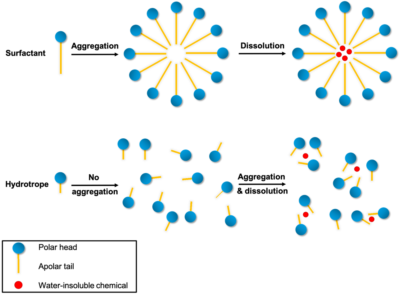
Mechanism of Surfactant and Hydrotrope
How Does Sodium Cumene Sulfonate Work as a Hydrotrope?
Sodium Cumene Sulfonate is chemically water-loving sulfonate group and an organic part. This structure is interact with water and with parts of the formulation that do not mix well with water. It does not simply dissolve everything. Instead it changes the environment around the formulation ingredients. It can reduce the chance that some components will separate into phases or form structures.
This is one reason Sodium Cumene Sulfonate 40% in formulation is relevant when discussing cleaning products.
In a formulation surfactant molecules can form structures such as micelles and other aggregates. When the concentration of surfactants and other ingredients becomes high these structures can become crowded or change shape. The formulation may then become cloudy, thick, unstable or hard to process.
SCS can influence this system. It helps maintain a balance. The exact result depends on the types of surfactants used how much SCS is added, the salts, temperature, pH and other ingredients. So sodium cumene sulfonate 40% as hydrotropes should be viewed as part of the formulation system, not a fix.
The Science Behind Hydrotropy
The science of hydrotropy focuses on how molecules interact within a system. Water molecules strongly to interact with water- substances while hydrophobic ingredients is not attract to water molecule. Surfactants is used to hydrophobic ingredient and hydrophilic material get close and make product miscible and clear form.
At concentrations surfactant systems can become complicated. A hydrotrope can modify these interactions. It makes it easier for the formulation to stay uniform.
One useful way to understand sodium cumene sulfonate 40% as hydrotropes is to think about the space between water and the water-compatible parts of the formulation. SCS can affect the balance between these components. It reduces association or separation. It may influence micelle structure, molecular interactions and the overall organization of the liquid.
The effect is not always the same because every formulation has a chemical environment. This is why laboratory testing remains important even when SCS has worked well in another product.
How Does SCS 40% Improve Formulation Clarity?
Clarity is often a quality feature in cleaning products. A formulation can become cloudy when an ingredient becomes poorly soluble when surfactant structures change or when different ingredients start forming a phase.
In some cases the product may look clear after production. It can become hazy during storage or after exposure to temperatures. A hydrotrope can help reduce some of these issues by improving compatibility among ingredients in the water-based system.
Sodium Cumene Sulfonate 40% in formulation can therefore be helpful when a clear or consistent appearance is needed. It may help prevent separation and reduce haze caused by compatibility between ingredients.
However, SCS is not a fix for every clarity problem. Cloudiness can also come from materials, hard water, salts, fragrance oils, pH changes, temperature effects or a wrong surfactant blend. The real cause should be found before increasing the hydrotrope level.
Sodium Cumene Sulfonate 40% and Surfactant Systems
SCS is especially relevant in formulations that have amounts of surfactants. Surfactants can create systems when multiple types are combined. A formulation may contain anionic or other surfactants. Each one can affect how the others behave.
As concentration grows the liquid may become hazy or develop phase changes. A hydrotrope can help make the system easier to handle and keep stable.
The use of sodium cumene sulfonate 40% as hydrotropes in these systems is not meant to replace the surfactants for cleaning or foaming. Instead it supports the formulation around them. It can improve ingredient compatibility. It may make concentrated products easier to manufacture and pour.
The actual effect depends on the combination. A level that works in one detergent may have an impact on viscosity or clarity in another formulation.
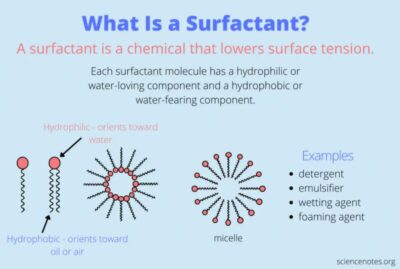
What is Surfactant
What Ingredients Can Sodium Cumene Sulfonate Help Solubilize?
Hydrotropes are often considered when a formulation includes ingredients that have low miscibility with water. Those ingredients may include surfactants, fragrance components, solvents, oils or other organic materials.
The need becomes more obvious when the formulation uses concentrations of ingredients. If an ingredient tends to separate or create haze the formulator can test a hydrotrope as part of the solution.
Examples of ingredients or systems that may benefit from a hydrotrope include:
- Blends that become cloudy or unstable.
- Nonionic surfactants that have compatibility issues at high concentrations.
- Fragrance or perfume components that cause haze in water-based systems.
- Some organic solvents can create compatibility problems.
- Hydrophobic ingredients that are hard to incorporate into a cleaner.
- Concentrated detergent systems where salt and surfactant interactions cause instability.
- Other formulation components that need compatibility with the water phase.
It is important to remember that Sodium Cumene Sulfonate 40% in formulation does not mean every hydrophobic ingredient will become fully soluble. The result depends on the chemical structure and amount of the ingredient.
In some cases another solubilizer, solvent, emulsifier or surfactant system may be required.
SCS 40% vs. Solvents: What Is the Difference?
A solvent is usually used to improve miscibility, solubility of formulation. For example a solvent may be added to help dissolve oil, resin, fragrance or another organic ingredient.
A hydrotrope has a broader formulation role. It can help improve compatibility within a water-based system without acting as the solvent for an ingredient.
With Sodium Cumene Sulfonate 40% in formulation the main goal is often to improve the water compatibility of the formulation. A solvent may be chosen to dissolve a component while SCS may be added to support the stability and compatibility of the mixture.
Sometimes both are used because they solve formulation problems. The right choice depends on the ingredient causing the issue, desired product properties, regulatory rules, cost and compatibility.
Sodium Cumene Sulfonate 40% in Liquid Cleaning Formulations
Products such as detergents, hard-surface cleaners, bathroom cleaners, kitchen cleaners, degreasers and other water-based cleaning products may contain surfactants and supporting ingredients.
These products must be required to stay uniform during storage while also delivering the expected cleaning results.
The sodium cumene sulfonate 40% as hydrotropes in a cleaner is usually to formulation stability and ingredient compatibility. It can help the formulator build a product without creating haze or separation. It may also improve processing by making the formulation easier to mix and handle.
How Does SCS Affect Viscosity?
Viscosity is one area where hydrotropes can have an effect. Rich mixtures often become thick because of the structures that form when surfactant molecules gather together. Adding a hydrotrope can alter these structures. In some cases this makes the mixture less thick.. The change might be small or different depending on the situation. How much the hydrotrope affects viscosity depends a lot on the system and, on whether salts or other materials are present.
This means that Sodium Cumene Sulfonate 40% in formulation should not be added just because a product feels too thick. First the formulator must find out why the viscosity is high.
If the high viscosity comes from a structure that responds to hydrotropy Sodium Cumene Sulfonate 40% may help. If the issue comes from a polymer, a undissolved material or any other ingredient the hydrotrope might not work as expected. Small lab tests can quickly show whether Sodium Cumene Sulfonate 40% is having the effect on viscosity.
Sodium Cumene Sulfonate and Phase Stability
Phase stability means keeping the mixture uniform and stopping components from separating into layers or particles. This is important for products that need to stay good for a time on the shelf.
Temperature changes can make phase stability harder. That’s because solubility and molecular interactions can shift.
Sodium Cumene Sulfonate 40% in formulation can help with phase stability by making some ingredients more compatible. It may help prevent components from pulling from the water phase.
Stability depends on the type of formulation, Packaging, storage temperature, water quality, pH, surfactant type, fragrance concentration, salt levels and the preservative system can all influence the result.
A product that looks fine for a days might not be stable enough for use.
How Much Sodium Cumene Sulfonate 40% Should Be Used?
There is no amount for how Sodium Cumene Sulfonate 40% should be used. The best amount depends on the ingredients their concentrations, the desired clarity, storage conditions and the specific problem in the formulation.
The supplier might suggest a range. Formulators still need to test the material in their system.
When working with Sodium Cumene Sulfonate 40% as a hydrotrope it is better to start with lab trials using amounts at once. Several small batches can be made with increasing levels of SCS.
Then the samples can be checked for appearance, viscosity, stability and performance. This helps identify where the hydrotrope gives the benefit without using more than needed.
The percentages used should be based on supplier guidance and formulation needs. These levels should not be treated as fixed rules.
Factors That Affect Hydrotrope Performance
Many parts of a formulation can change how Sodium Cumene Sulfonate 40% performs. The type of surfactant matters because different surfactants form structures in water.
Salts and other electrolytes can also change behavior. PH can affect how ingredients mix. Temperature can change solubility and phase changes.
The amount of solvent and fragrance can also change how much hydrotrope is needed.
When testing Sodium Cumene Sulfonate 40% in formulation formulators should consider:
- The type of surfactant and how much is used.
- The amount of salt or electrolyte.
- The pH of the product.
- The temperature during processing and storage.
- The amount of solvent present.
- The type of fragrance or oil.
- The hardness of the water.
- Other ingredients that support water compatibility.
- How the product is stored.
- Whether SCS is compatible with all materials used.
Looking at all these factors together helps explain why a formulation works or Doesn’t work.
Sodium Cumene Sulfonate 40%: Benefits and Limitations
One benefit of Sodium Cumene Sulfonate is that it can help ingredients that do not normally mix well become more compatible in water-based products. It can be helpful in cleaning products. It can assist with clarity mixing and controlling viscosity.
Because Sodium Cumene Sulfonate 40% is usually supplied as a liquid it can also be easy to handle during production.
At this time Sodium Cumene Sulfonate 40% as a hydrotrope has limitations. It cannot make every oil or water-insoluble material fully water-soluble. Using more does not always bring results.
Much hydrotrope can change viscosity, texture, cost or other characteristics. Some formulations may perform better with a hydrotrope, a solvent, a solubilizer or a combination.
The right choice should come from testing of the formulation not from the name of the ingredient.
How to Evaluate SCS 40% in a New Formulation
A laboratory test can show whether Sodium Cumene Sulfonate 40% is useful in a formulation. Start with the formula as the control. Make batches with amounts of SCS.
Keep variables consistent so it is easier to see the hydrotrope’s effect.
Samples should be checked away and again after storage. Useful evaluations include:
- Appearance and clarity
- Presence of particles
- Separation into layers
- Viscosity
- pH
- Weight, where relevant
- Stability at temperatures
- Freeze-thaw behavior, where applicable
- Ingredient compatibility
- Product performance
- Changes in color or odor
- Long-term stability
The goal of testing Sodium Cumene Sulfonate 40% in a formulation is not just to get a product that looks good at the start. The final product must also perform as intended. Stay stable over its expected shelf life.
Sodium Cumene Sulfonate 40% as hydrotrope vs. Other Hydrotropes
SCS is one of kinds of hydrotropes that are used in making products. Other hydrotropes can have chemical setups and may act differently on clarity, thickness, surfactants, how they work with salts and the cost of the formula. There is no one hydrotrope that works best for every system.
When comparing SCS 40% hydrotrope with another hydrotrope formulators should look beyond the active part. Important questions are how well each material works with the mix how much is needed how it changes the thickness if it stays clear in cold weather and if it works with the right salts and pH. The best choice for a product is the one that works well and is affordable for the formula.
Conclusion
Sodium Cumene Sulfonate 40% in formulation is mainly used as a hydrotrope to improve compatibility in water-based systems. Its value is most noticeable when a product contains levels of surfactants or other ingredients that're hard to keep uniformly mixed in water.
By changing how water, surfactants, solvents and oily ingredients interact Sodium Cumene Sulfonate 40% can help reduce cloudiness and separation. It can also make the product easier to process. It can influence viscosity, which may help when a formulation becomes hard to manufacture or handle.
The key idea is that Sodium Cumene Sulfonate 40% as a hydrotrope should be seen as part of the formulation system. How well it works depends on type, salt concentration, pH, temperature, solvent level, fragrance, water quality and many other factors.
There is no amount that fits every product. Small lab trials followed by stability and performance testing are the way to determine the use level.
For manufacturers of detergents hard-surface cleaners and other water-based products Sodium Cumene Sulfonate 40% can be a tool, for solving compatibility and stability issues. The goal is not simply to add a hydrotrope but to find the level that delivers the appearance, stability, viscosity, processability and performance.
When tested properly as part of the formulation Sodium Cumene Sulfonate 40% can help make tough formulations easier to make, store and use.